
Why Mesquite is One of My Favorite Fretboard Woods
A love letter to mesquite, since I don’t see many using it for fretboards and folks are often surprised when they find out that I do.
What is Mesquite?
Mesquite is a small tree (sometimes classified as a shrub) that grows natively in the southwestern US and Mexico. You have probably heard of it as a popular BBQ smoking wood, or as a flavor note in BBQ sauces. I do use mesquite cutoffs and scrap in my smoker, but that’s not why it’s one of my favorite fretboard woods.
My Experiments with Alternative Fretboard Woods
If you’ve some reading on this site or listened to me ramble about wood elsewhere, one of the top priorities around here is building great guitars from sustainable materials. This had lead me to try a lot of unconventional materials for fretboards: domestic-grown sissoo rosewood, Texas ebony, black walnut, richlite (yuck)… and mesquite. I’ve also used the conventional fretboard woods that you’d expect: maple, Indian rosewood, Brazilian rosewood, and ebony (note: I still acquire these sustainably – for maple that means local salvage, and for the others it means secondhand sources like new old stock, estate sales, repurposing, etc) . I have found that any of these can be used to produce an excellent fretboard and would happily use any of them again (except richlite). The experiment continues on, and there are many woods I plan to try: cherry, birch, Osage orange, and pecan are high on that list.
How Does Mesquite Stack Up?
I first considered mesquite when I saw it in stock from a salvaged lumber supplier in Texas, probably while on the hunt for Texas ebony. I did a little research (The Wood Database is great for this, and the source of the stats shared below) and thought its properties sounded perfect for fretboards. For fretboard woods, I am most concerned with Janka hardness, weight, stability/shrinkage, look and feel, and availability. I want it to perform well, look and feel great, and be reliably available from sustainable sources.
Mesquite checks these boxes. *NERD ALERT, READ ON AT YOUR OWN RISK* It has a Janka hardness of 2,340, right about the same as Indian rosewood (2,350), significantly harder than hard maple (1,450), and not far behind Brazilian rosewood (2,790) or ebonies (3,000+). Its average dried weight is 51 pounds per cubic foot, not much heavier than hard maple (44 lbs), slightly lighter than Brazilian (52 lbs) and Indian (53.4 lbs) rosewood, and much lighter than Macassar ebony (70 lbs). Once you start to compare stability (using shrinkage as the measurement), mesquite really starts to stand out. It is a very stable wood, the least susceptible to shrinkage of any being compared here – Mesquite averages 1.6% radial shrinkage and 3.2% tangential shrinkage, for a total of 4.8% volumetric shrinkage and a tangential to radial ratio of 2. Compare to: hard maple (4.8% R, 9.9% T, 14.7% V, 1.9 T/R); Indian rosewood (2.6% R, 5.9% T, 8.6% V, 2.3 T/R); Brazilian rosewood (2.9% R, 4.6% T, 7.5% V, 1.6 T/R); and Gaboon ebony (8.3% T, 11.2% T, 19.6% V, 1.3 T/R). All have similar ratios (a good indicator of stability), but the sheer volume of shrinkage is lowest for mesquite, in some cases dramatically so.
All of this is to say that mesquite is exceptionally hard and stable, without adding too much weight to the neck. Yes, ebonies are harder and have the best T/R ratios, but you pay for these benefits in weight, and heavy necks can lead to neck dive. Indian rosewood and maple are the most commonly used neck woods today, and I would argue that mesquite performs equally or better than them in every category (except that maple is SLIGHTLY lighter). Brazilian rosewood probably offers the best combination of hardness, weight, and stability, but I don’t think this is news to anyone, and that’s why it’s all but extinct.
How does Mesquite Look?
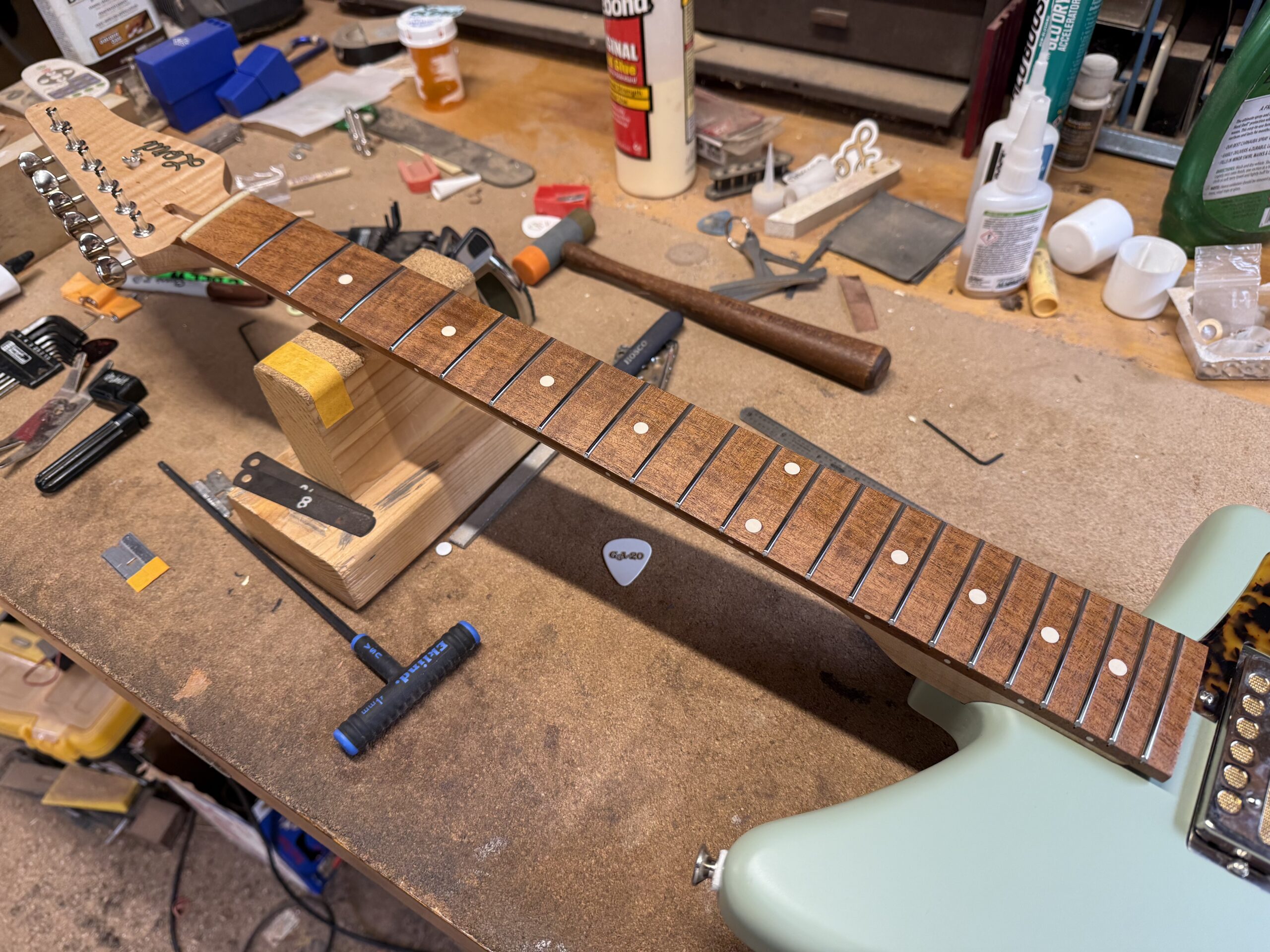
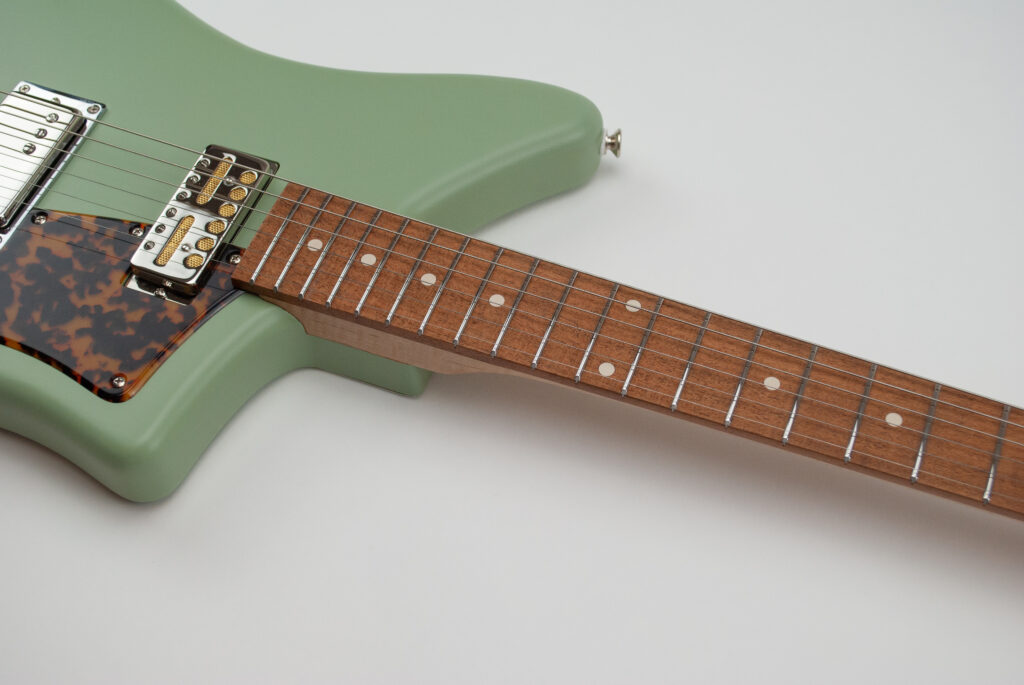
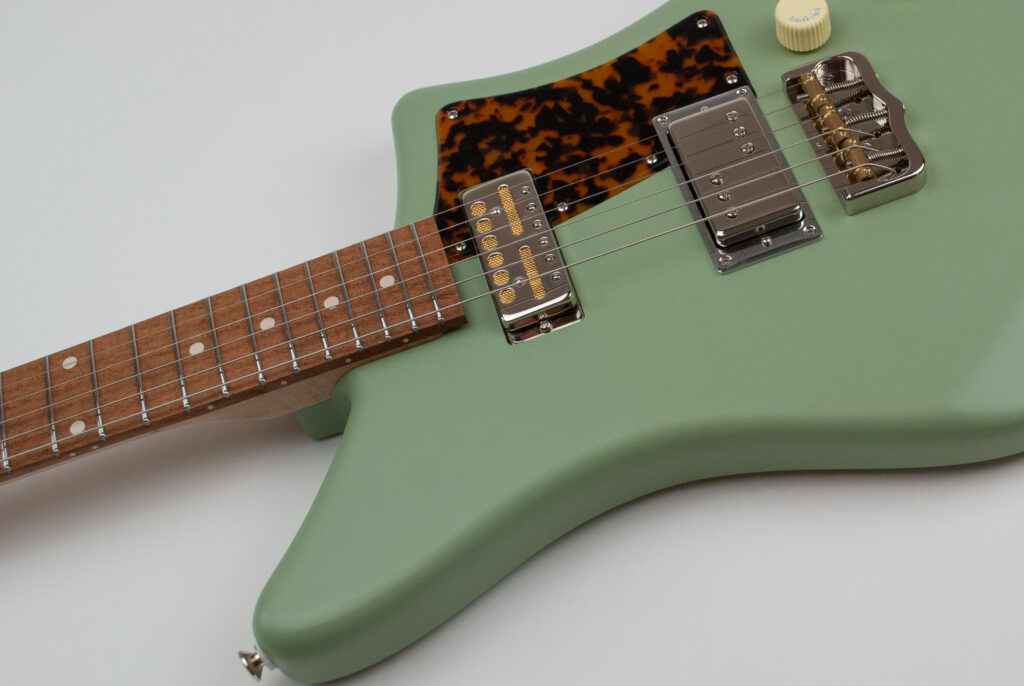
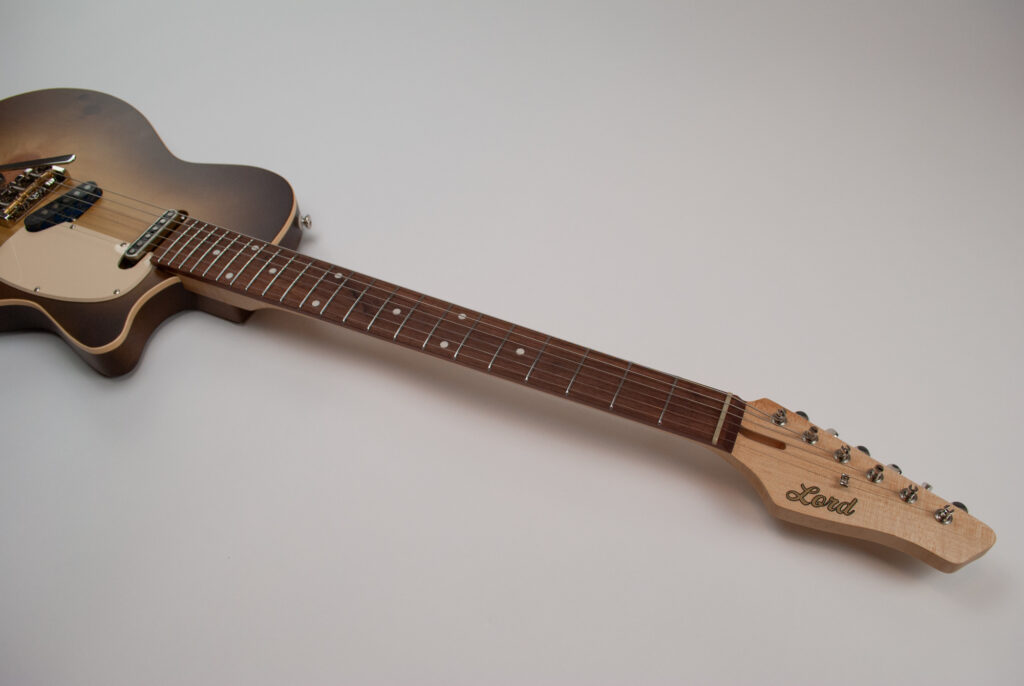
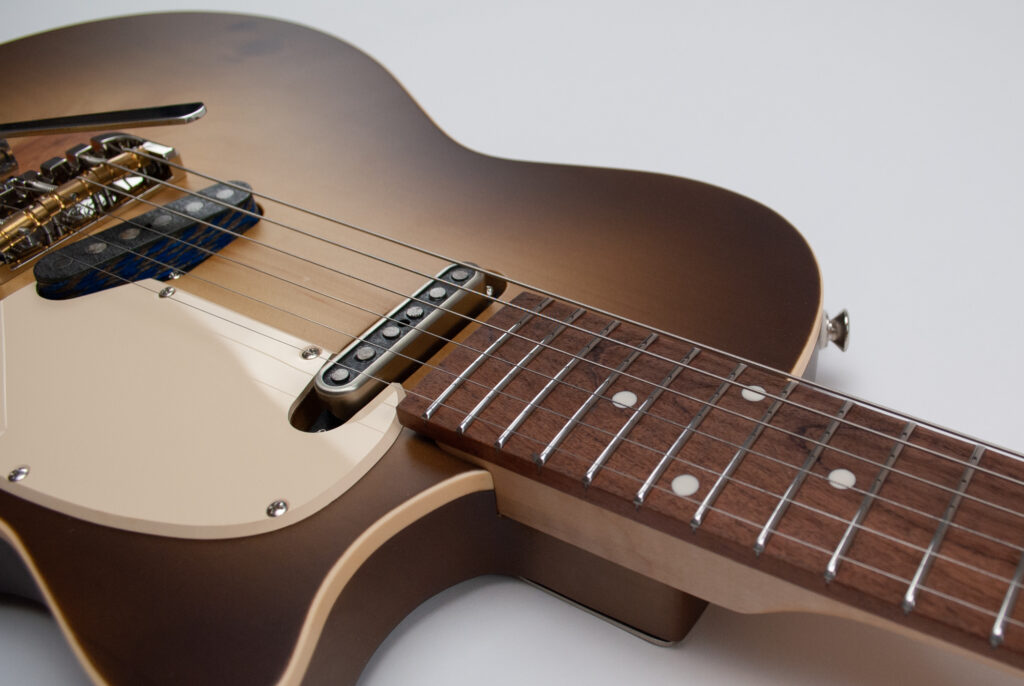
Does it look good? Looks are always subjective, but I think so. It is a nice reddish brown that darkens up with finish or oil, has fairly pronounced wood grain, and can even have a curly figure. When I use mesquite fretboards, people usually assume they’re something like pau ferro, jatoba, or just lighter shaded Indian rosewood. I think they look right at home as a guitar fretboard, and here are some examples:
Where to Get Mesquite Lumber
If you’re in the US or Mexico, you’re in luck: mesquite grows domestically there. It is available from sustainable sources like independent sawmills/sawyers, who are able to get mesquite from fallen trees or residential/municipal removals. I have purchased mesquite from The Wood Fairy and Berdoll Sawmill, and had great experiences with both. Berdoll is probably the top mesquite supplier out there, offering multiple grades of lumber as well as live edge slabs.
If you’re looking for slotted mesquite fretboard blanks, shoot me an email. And if you can recommend other suppliers for mesquite, or your own experiences with alternative and sustainable fretboard woods, leave them in the comments below!
-Nate
This Post Has 0 Comments